
The jewel of Zala County: Zalakaros
The first reliable written reference to the settlement dates from 1254, when it is recorded as a royal estate until 1355. Subsequently, King Louis the Great granted the village to the Óbuda Chapter as compensation, after which Karos became an ecclesiastical estate for many centuries, right up until the arrival of the Ottoman Empire in 1566. Life was not easy for its inhabitants, living as a border village on the fringes of the Ottoman Empire, in the shadow of the crescent moon, under the protective wings of Kiskomár Castle. But the real struggle for survival took place during the Turkish wars, and lasted until the recapture of Kanizsa Castle. The organisers of the campaign had planned to capture Kanizsa through a siege and starvation, which is why the settlements in the surrounding area were destroyed in 1687 and their inhabitants driven away for years. It was only following the surrender of Kanizsa in 1690 that the people of Karos were able to return home after three years and begin rebuilding their houses and cultivating their land in the village, which had been reduced to a wasteland. By 1700, sources mention 11 inhabited semi-serfhold estates and a functioning mill. The settlement developed slowly; the first Hungarian census (1784 and 1787) already mentions 98 families living in 78 houses, with the village’s population standing at 564. Although 18th-century records refer to Karost as a market town once again, they clearly show that it remained, in reality, a small village. The daily lives of its inhabitants were occasionally disrupted only by the odd significant event. The first major tragedy occurred in 1794, when a quarter of the village burnt down in a short space of time, but the villagers were quick to get back on their feet. Viticulture and wine production, as well as livestock farming, have always played a prominent role in the lives of the people and in the village’s economy.
In 1848–49, several men from the village served as members of the Honvéd in the battles of the Revolution and War of Independence.
Religious life was strengthened by the construction of St Anne’s Church between 1864 and 1866 to „replace” St László’s Church, which had been destroyed during the Ottoman period. The town’s second church, the Church of Divine Mercy, was consecrated in 2006, and the town was granted parish status in 2014.
Karos was given the ‘Zala’ prefix by the Ministry of the Interior in 1908, to distinguish it from the settlement of the same name located in Bodrogköz. Several explanations have been put forward for the origin of its name; it is likely to derive from a variant of the given name Károly. It was at this time that its coat of arms was also approved: a red shield with a pointed base, featuring a tree in the centre of the green base, a scythe on the right-hand side and a sheaf of grain on the left. Thus, the settlement’s traditional colours are red and green.
The Heroes’ Memorial on Heroes’ Square honours the victims of the First and Second World Wars.
During the first six years of the council system, not much happened in the village; in the early 1950s, everyone was struggling to make ends meet – this was the era of compulsory collections. The 1956 Revolution passed without any significant incidents, apart from minor local uprisings. This was followed by a more consolidated era of socialism, the development of which was largely determined by the emerging spa and the associated developments. Although the town had survived the Tatars, the Turks and both world wars, there were worrying signs regarding its future in the 1960s. This was not only because Zalakaros was one of the smallest settlements in the region, but also because its population was steadily declining, reaching a low of 695 by 1970. Had nothing extraordinary happened, we might have shared the fate of the average small village in Zala County. But 50 years ago, something extraordinary did happen: building on the water discovered as a by-product of oil exploration, the first bathing pool was opened.
And what did this mean? Among other things, it meant that from that point onwards, the population has been growing steadily, and now stands at 2,400.
Looking back over the history of our town, which spans more than three-quarters of a millennium, it can be divided into two main periods. The first covers the 711 years following 1254, whilst the second covers the last 50 years. In other words, what happened before the spa was established and everything that came about afterwards. Until 1965, there were only a few news reports in Hungary about this small settlement, whose population never reached a thousand, and which played a subordinate role amongst its larger neighbours.
Could one say that Zalakaros is synonymous with the spa? Perhaps, but Zalakaros is, of course, more than just the spa. To the rest of the world, however, Zalakaros is still synonymous with the spa.
The spa’s origins date back to 1962, when, as a result of a test drilling carried out by a hydrocarbon researcher, water at a temperature of 96 °C gushed to the surface instead of oil, and this became the foundation for everything. Instead of the expected „black gold”, hot water gushed skywards; this fact gradually sparked people’s imagination, and many took action. As a result of lobbying and the organisation of community work, the Karos spa was established a few years later. On 5 September 1965, the spa opened its doors with the following words from Dr János Benkő, Chairman of the District Council Executive Committee: “We wish all those present here, and all workers who come here to relax and recuperate, that the spa may provide everything they expect of it, and that as many people as possible may use it to maintain and restore their health.” This wish came true: over the decades, a population equivalent to twice that of Hungary sought relief from their ailments in Zalakaros. It is significant that on 16 July 2010, the 20-millionth visitor crossed the threshold of the new reception building.
The year 1975 marked a milestone in the development of both the spa and the village. It was then that the indoor spa building was opened, putting an end to the seasonal nature of the Zalakaros spa and laying the foundations for the therapeutic use of the medicinal thermal water. In the years that followed, the spa continued to expand steadily, with more and more pools being built, thereby significantly increasing the water surface area.
In 1978, the Ministry of Health officially designated the spa, renowned for its „therapeutic waters”, as a therapeutic spa. And a major leap forward in terms of continuous development: the adventure pool was introduced in 1999 as a first in Hungary. And the latest development: the creation of the children’s worlds and the family pool in 2012 and 2013. This has opened up new opportunities, as evidenced by the growing number of visitors. Naturally, we have not forgotten about medical treatments or our traditional values either.
Alongside the development of the spa, tourist accommodation capacity also expanded at a rapid pace. In addition to hotels, private accommodation options began to appear. A significant expansion was the seven-storey SZOT Health Resort, which opened in 1983 and was connected to the spa by an underground passageway. Since then, accommodation capacity has continued to grow; four-star hotels have appeared, restaurants have opened, and a steady stream of new services has emerged to meet the demands generated by tourism. As a result of all this, the small village has developed at a rapid pace.In 1987, the gas supply scheme was completed, followed by the telephone network; in parallel with these, the sewerage network was constructed and modernised, and the increasingly comprehensive infrastructure was developed – a process that continues to this day. Key milestones in this urban development were the village’s designation as a large village in 1984, and then its designation as a town on 25 July 1997. This transformed the medieval and early modern market town into a modern town, proving that it could make the most of its natural endowments and opportunities.
The driving force behind all this was the spa, which, as a result of ongoing improvements, has now been completely refurbished. These investments have enabled improvements to the spa that have enhanced both its quality and capacity, which not only ensured the long-term development of the limited company but also had a positive impact on the development of Zalakaros, the tourism service providers operating in the town, and the surrounding micro-region. In terms of tourism indicators, we rank amongst the top 10 nationally, but we are also proud to live in one of the country’s safest, cleanest and most flower-filled towns. We are proud that people are keen to choose Karost as their home.
Our town’s slogan: Draw strength from the wonders of nature! This phrase encapsulates one of nature’s wonders – the medicinal waters – as well as our environment, which is of outstanding value, our forests, lakes and the diversity of the landscape. The unparalleled natural and historical treasures of Kis-Balaton. Today, by utilising the overflowing thermal water – whilst showcasing the area’s natural assets – we have created a thermal lake, which, together with the attractions being developed alongside it, provides further leisure opportunities for both local residents and visitors. We are developing cycle tourism on a large scale – alongside the renovation of existing routes, we are also building new ones. We have drawn up our town development plans for the future; we have dreams. Just as the creation of the spa was a dream that came true, we have not given up on realising our dreams for today either.
In recent years, Zalakaros has been positioning itself as the family spa resort of the Balaton region. Children are our youngest guests; they are our future. We are confident that they will keep coming back to us, and as they get older, they will naturally make use of different attractions, such as the sports pool and the larger slides. Then they will return with their own children, and 50 years from now they will soothe their aching limbs in one of the continent’s most effective therapeutic waters, the Karosi. I hope that my vision will come to fruition, just as I hope that people of all ages will find fulfilment and joy at the Karos spa.
Finally, we might ask: Do the first seven centuries of the settlement’s history not matter, are they not of interest? Of course they do. Not just because the people who lived here did what had to be done with honour. Not just for that reason. Because without our traditions and the values of our past, we would not be Hungarians, we would not be people of Zalakaros. The values of our past, the efforts of the present and our faith in the future together make up the wholeness of Zalakaros.
We would like to thank all the people of Zalakaros, the „honorary residents of Zalakaros”, and everyone who has done anything to enhance the treasures of Zalakaros for the results achieved.
Ferenc Novák
Source: György Lovász, Ferenc Gyulai, Ferenc Ördög, László Vándor, Imre Halász, Edit Kerecsényi and Ferenc Novák, *Zalakaros* (2000, Monograph)
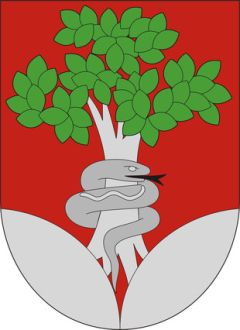
The coat of arms of the town of Zalakaros:
On a red field within a round-based shield, a silver-coloured snake, coiled three times around the silver-coloured trunk of a tree with green foliage, starting on the right and turning to the left. The tree, with its roots extending from the centre of the shield’s base, grows out from between two silver-coloured hills curving out on either side.
The city’s colours: red – green